Friday, December 23, 2011

Gingerbread baking as aquantum phenomenon

Baking gingerbread is a christmas tradition in where I come from. Now a very peculiar thing happened to me while my wife was doing that, and it made me wonder the true spirit of the event. See, my wife put the gingerbread into the oven and asked me to wath that it does not burn. I wanted to clarify some things about it, so I asked her that is she sure that wathing will prevent it from burning. So I did what was told. I wathed, and she was right, the gingerbread did not burn. During the next round I found an interesting newspaper article, and forgot to look. The gingerbread ended up black.

I am amazed! This means two things. First of all, baking gingerbread in our kitchen oven must be a true quantum phenomenon. This alone is extremely surprising. But not only that, also it means the Copenhagen interpretation of quantum mechanics, presented by Bohr and fellows (and which is nowadays considered as old-fashioned and misleading) has been proven right using a real-life experiment!


Wednesday, December 14, 2011

Of lazyness and comfort

Man's gratest inventions are result of his lazy nature and predisposition to seek comfort.

For instance being able to warm up your nice little cave and cook the food using fire, at the same time providing light for doing some decoration on the walls, is just comfortable, isn't it?

  • A lazy man tired of dragging heavy items, invented the wheel
  • A lazy man tired ot pulling wagons, invented domestic horse
  • A lazy man carrying water buckets invented the water pipe system
  • A lazy man that didn't enjoy the smell, inventedsewer system
  • A lazy man that had terrible hand writing, invented typewriter

Next time you are being called lazy and inefficient, you can quote me by saying: Lazyness is a fundamental, built-in quality of man, and has caused man to create all the inventions so far. Had man been truly diligent, we would all still live in that cave and eat raw flesh, because it is possible to survive with that.

And yes, lazy we still arel, as there are still lots of new inventions to be made. Be lazy, and be proud of it!

Exoplanet

So they found an extrasolar planet where conditions are very much like ours in here. Now I'm not even sure how should I deal with that piece of news. Should I be excited? Why?

First of all, I don't think traveling to the planet is going to be possible. Although it is fairly close (352 light years away), it is still quite far. Let's do some calculation. One light year equals 10^16 kilometers. According to some references, he fastest spaceship human has built so far, has travelled 15 kilometers per second (which is terribly fast if I may say). Let's use that speed. We will divide 352*10^16 with the speed and get the travel time in seconds. The result is a bug number, which we again divide with 60*60*24*365 to get the travel time in years, instead of seconds.

The travel time will be 7441 million years. That's way longer than the age of human species. Not feasible. We will have to settle and study the planet remotely.

Why? Is the planet more interesting because it is like our planet? I know. The discovery encourages speculations of extraterrestrial life. But on what grounds? Is it more likely to find life on similar planets than earth than different planets? Is it likely to find life on exoplanets at all?

Every mathematician knows that making a statistical analysis becomes unreliable when N is small, and completely pointless when N = 1.

Monday, December 12, 2011

Colors of the world

We see our world in colors. That's very natural. It is so integral part of our world that we could not imagine a world without colors. When I was a kid my father took a lot of black and white photographs with his camera. I asked him that why do they look like that, with no colors and all. He explained that the color photographs require more complicated technology than black and white. The answer did not satisfy me - I claimed that wouldn't it be more simple to picture the world as it is rather than to filter some very carefully selected colors (like red, green, yellow and so on) of the picture out and leave some (like black and white) untouched. To me it seemed that it would require more advanced technology. i don't remember if my father could answer anything to that. Maybe I was a difficult kid with all my questions.

The true color of an item is actually a function of amplitude that it reflects for different frequencies of white light. White light of course is something that has an equal amount of all frequencies of light. The amount of different variations and combinations of colors is endless!


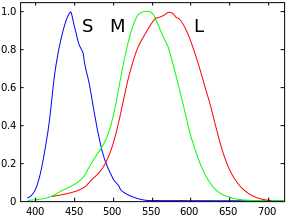
How does then human eye perceive color? The retina inside human eye has dedicated cells to react in three different wavelengths. Only three. This means that of all the different wavelengths most are totally ignored, or they are observed as combinations of colors. For instance if there is an object that reflects light at 500 nm wavelength, we most likely observe the object being cyan. However, we also observe the combination of blue and green lights as cyan color. With our eyes, we just can't see the difference.

The above leaves one question open: why? Why do we recognize some frequencies of light so well and some roughly? There must be a reason, and the reason must be in human evolutic history.

For evolution in general, it must have been quite important to distinguish green leaves from blue sky and water, to be able to navigate and move quickly, and to be able to find water. Originally it must have been a great asset in both hunting and escaping hunters. I imagine this skill must have developed quite early, after life moved from sea to land.

What about red then? What could have been the driving force to make us observe red light? When did that happen? Which animals are capable of observing red anyway? (For instance bulls do not, which means the matador's equipment could be practically any color, causing an equal effect.) Maybe red color has come to enhance the seeing capabilities, because most of the colors you find in nature (plants, rocks, sand, dirt) are in this specific area, so to be able to observe your surroundings it was very useful to recognise the frequency of the color more specifically, Now it was able to recognise for instance brown rock from green grass, and see where to go next.

The fact that human can observe three colors also lead to technical decisions: all video and image formats, television and camera hardware, transmission protocols etc. they are all based on the assumption that vision is composite of three colors. And this is the case when we talk about humans. Imagine that an alien race would come to earth that has a similar vision but perceives more colors, or colors of different wavelengts than us. They could not watch TV or movies, use our computer monitors, see color prints, or even those old-fashioned photographs properly!


Monday, November 28, 2011

Ladders of philosophy

A person can quite easily evolve his thinking capabilities in everyday life. Let's take an example. Taking out the garbage is ordinary physical work, while thinking about taking out the garbage is a small-scale philosophical experiment. Here a person has climbed one step on the philosophical ladder.

Next step in this ladder is to evaluate the thinking process, and during this evaluation, observe what is a person's motivation to use brain capacity to think about taking out the garbage. Obviously, the highest philosophical ladder is reached when one comes to the conclusion that thinking about thinking about taking out the garbage is a waste of brain capacity and falls into a state where there are no thoughts at all.

Not all persons understand the importance of climbing philosophical ladders. Such persons insist on sticking on the first stage on the example given above. Such persons, let's say for example a wife, will use first seemingly strong arguments, then brute force to convince that it is actually a good idea to take out the garbage, but in reality that kind of persons are just trying to limit one from improving his mental capability.


Tuesday, November 8, 2011

Three (?) phases of matter

(pic from www.stonecropgallery.com/artists/caleb.php)

At school I was taught that the matter has three phases: solid, liquid and gas. That was given as a truth, and it remained as such for a very long time. All the phases could be easily understood. The little physicist in me was satisfied. Everything was explained logically and for instance water, the most familiar and friendly of all elements, could be seen in all its states, and even transitions from one state to another can be observed visually. Everything made sense. How much I miss those days.

The first crack in my illusion of physical perfectness was caused by bubble gum. It was suddenly brought to my attention that there are materials that are neither solid nor liquid, but in between. They do not have a melting point, but the degree of "liquidness" does depend on the temperature. "Amorphous solids", someone explained to me. I was not satisfied with the explanation, I felt like I had been betrayed. But it did not end here, it was only getting worse.

Plasma was introduced. If you heat matter enough, electrons will have so much energy that they escape the orbit of the atoms, and the matter will become a mess of ionic nucleons and electrons. The mess is called plasma. But if you heat it even more, the nucleons will no longer stay together but the quarks will instead lose their connection. The quark plasma can not be created in your fireplace, not even in nuclear plants or bombs, but that was the temperature a couple of nanoseconds after the Big Bang.

From hot to cold. Satyendra Nath Bose presented a theory that in very cold conditions matter would start behaving very differently from normal. Bose-Einstein concentrate is again a new phase of matter.

A quick look to reference material reveals the horrible truth: if you count everything, there are nearly 20 different states of matter. It is completely up to you what to include in the list. It really depends on the matter we are speaking about, and who is listing. Chaotic.

I am now relying on quantum physicists to convince me that in fact there are no phases of matter at all, there is only energy. The so called "phases" are just an illusion that is caused by complex emergent properties of how different kinds of quantum fields interact with each other. And really what determines different melting points for different materials is - at the end - the properties of the world: Planck time and distance, cosmological constant, number of dimensions. Those determine all phases of matter, and all melting and vaporisation points. Mathematic simplicity.

That is what I would like to hear, it would bring back peace.

Sunday, October 16, 2011

Modeling the universe

Let's play a little mind game. Imagine that you knew everything about physics and you had unlimited computer processing power. Using a computer program you could realistically model how particles interact with each other. What could you accomplish?

First of all, you could simulate all chemistry. Just given the formula, and you could calculate its melting and vaporizing temperatures and other characteristics. After all, chemistry is all particle physics. I guess that can be done even today, to some extent.

Next, you will model a couple million billion particles that are shaped like a vacuum cleaner. This experiment sucks, you think. Let's try something more interesting. You will model a life form - bacteria, and watch the life form fill the memory of your laptop. How nice.

How about modeling a human brain? Let's do it. After all we do have unlimited resources. The brain is modeled, but is very little fun, because you did not model a mouth for it to speak its thoughts. So you don't even know if your brain is  conscious. After a short while you get bored of your brain-experiment and stop the simulation, but after doing that, you stop and wonder that did you just kill someone.


You buy some more memory for your computer, as you intend to simulate the entire universe. Now this adding quite a lot of particle x, y and z coordinates and quantum states. As you would like to avoid this, you decide to model the singularity where it all started instead. It will be much easier that way. Your own personal universe starts developing.

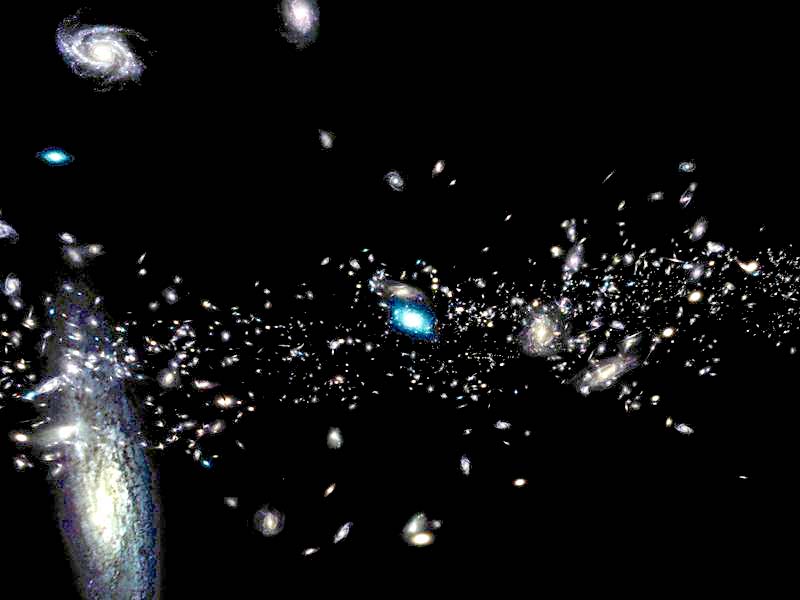
Now assuming that the physics of the modeled world correspond to physics of our world, what's the difference between the modeled universe and our universe? Nothing, really.

But there are some requirements to the computer. The computer must be very large. Most likely it should weight more than the system it is modeling. So if it models the state of every particle in the universe, the computer would weight way more than our current universe. Also, the time that it takes for modeling will be at least same than time that is being modeled, which is the age of the universe. The performance of the computer... well, we run out both the prefixes of flops and the Planck constant.

And there is one more limitation. This modeled process should follow the principles of quantum mechanics, to be able to simulate our world. And due to those principles, it is impossible to measure anything without affecting it. If you wanted to really create a model of  universe, you should isolate it completely from outside world, to protect our modeled word quantum state from decoherence. You should start the simulation and never have any interaction to it. And that means you will never know if it works or not. Or if you take a peek, you, the modeled universe's Creator, will alter it.