What happens when a software engineer writes about philosophy? Can it be considered philosophy at all? What is the definition of philosophy? If one tries to define it (as my engineer brain automatically starts doing) is it a mistake to start with? is this a good blog description? No!
Friday, September 2, 2011
Mirror
This is a puzzle that I created for my own amusement when I was about 10 years old:
A mirror is 2-dimensional, and it reflects a projection of 3-dimensional objects. Those two dimensions are: up-down and right-left. Now have a look at a mirror and raise your right hand. Your reflection seems to raise his left arm. If your T-shirt has some text, it also seems to have inverted from left-to-right to right-to-left, making it difficult to read. Conclusion: mirror seems to invert its left-right axis, but NOT its up-down axis. This is odd. How can it be? As scientists, we should make a hypothesis on what could cause this phenomenon ant test it!
Maybe mirrors have some kind of grid creating a polarization-like quality that explains this effect. Let's try to rotate the mirror 90 degrees. if this quality is in the mirror, then it should stop inverting left-right axis and start inverting up-down axis. A good scientist will always test his theory. After rotating the mirror, no change. No luck here, so this is obviously not the cause.
Another theory: maybe this is because of the alignment of human eyes: after all they are aligned horizontally and not vertically. Horizontally alighed eyes cause left-right to be inverted. If eyes would be aligned differently, the result would be different. Can this be tested? I close my other eye, no change. I even tilt my head so that my eyes are in different alignments, and still all text reads backwards, never upside-down.
After some thinking, naturally, I did come to a conclusion. What about you?
Monday, August 22, 2011
How speaking works
Exactly how does speaking work? What happens in human brain? Surely it requires a lot of processing power? To be able to speak meaningful sentences out fluently, one must be able to plan what to say next, organise the words of the current sentence into correct order and pronounce the current word correctly. And speaking can not take your whole attention, you must be able to for instance walk at the same time.
According to studies, following parts are most active when we speak:
These processes all work in parallel, without planning the whole sentence beforehand. When you are speaking a certain word of a sentence, you will probably know what you are going to say in that sentence in abstract level, but you don't necessarily yet what the words will be, and in what order they will come, until they do.
Let us look at some everyday examples, for how they fit to the model we have created:
Synonyms.
Sometimes it happens that when one speaks, there are two equal synonyms to choose from, but unable to choose quickly enough, the spoken word will come out as a funny combination of the two synonyms. The speaking processes feedback mechanism will quickly detect this error and the speaker will correct the mistake. But what happened? An easyexplanation is that the word-choosing process was not quite finished when it had to output the net word to the speech generation process. This caused the word to change in the middle of being pronounced.
Lost for words.
The same applies when a suitable word can not be found even if one has the idea ready. The database query just does not seem to produce any results, or the results are in wrong language. In this situation the speaker will either use some fill words to buy some time for extended database search - or return the control to the preparatory process and re-form the sentence so that the specific word would not be needed.
Blackout.
This has happened to me, and I don't think I'm the only one. When completing a sentence, there is no next sentence available in queue, or the next sentence does not seem to have anything to do with the one you just finished. I can imagine this as a synchronisation problem in Lateral sulcus: it is working too fast. the human communication transmission method has a very limited bandwidth, and the speed of thought must keep in sync in order for the opponent to understand the speech. I assume the blackout is a result of the monitor, which is observing our own speech and providing feedback to the processes of what our own speech sounds like, real-time. If the lateral sulcus notes that the speech in the feedback channel does not have anything to do with the idea or sentence currently being prepared, the process will halt.
A great article: Connections between thought and language
According to studies, following parts are most active when we speak:
- auditory cortex
- lateral sulcus (producing spoken language)
- temporal lobe (meaning of heard words)
- Wernicke's area (language comprehension)
- Broca's area (speech generation)
- motor region
These processes all work in parallel, without planning the whole sentence beforehand. When you are speaking a certain word of a sentence, you will probably know what you are going to say in that sentence in abstract level, but you don't necessarily yet what the words will be, and in what order they will come, until they do.
Let us look at some everyday examples, for how they fit to the model we have created:
Synonyms.
Sometimes it happens that when one speaks, there are two equal synonyms to choose from, but unable to choose quickly enough, the spoken word will come out as a funny combination of the two synonyms. The speaking processes feedback mechanism will quickly detect this error and the speaker will correct the mistake. But what happened? An easyexplanation is that the word-choosing process was not quite finished when it had to output the net word to the speech generation process. This caused the word to change in the middle of being pronounced.
Lost for words.
The same applies when a suitable word can not be found even if one has the idea ready. The database query just does not seem to produce any results, or the results are in wrong language. In this situation the speaker will either use some fill words to buy some time for extended database search - or return the control to the preparatory process and re-form the sentence so that the specific word would not be needed.
Blackout.
This has happened to me, and I don't think I'm the only one. When completing a sentence, there is no next sentence available in queue, or the next sentence does not seem to have anything to do with the one you just finished. I can imagine this as a synchronisation problem in Lateral sulcus: it is working too fast. the human communication transmission method has a very limited bandwidth, and the speed of thought must keep in sync in order for the opponent to understand the speech. I assume the blackout is a result of the monitor, which is observing our own speech and providing feedback to the processes of what our own speech sounds like, real-time. If the lateral sulcus notes that the speech in the feedback channel does not have anything to do with the idea or sentence currently being prepared, the process will halt.
A great article: Connections between thought and language
Wednesday, August 3, 2011
Famous two space ships problem
Following is an often-used example to illustrate similarities in gravity and acceleration.
There are two space ships. One of them is standing still on earth, and the other is in space, thrusting with constant force and therefore accelerating exactly at 9.807 m/s2, which happens to be exactly the same as the gravity constant on earth. A person is standing in both of the rockets, but they were brought to the ship in a way that they do now know which ship it is. Assuming the passenger cabins are completely isolated from the environment (no windows, sound protected), would there be any means for the passenger to find out somehow which ship it is?
Let's try some classic Newton physics. Jumping around or throwihg around objects will feel exactly the same on both ships. No help there.
If classical physics does not help, what about relational physics then? Let's try to measure speed of light for instance. Maybe the moving ship will capture rays of light differently than the ship that stays still? Unfortunately not. Speed of light is constant and does not depend on the speed of the observer. Besides earth is also moving, very fast. Our galaxy is not staying still.
Butwhat happens when the accelerating ship starts to reach the speed of light? The Lorenz formula below can be used to calculate moving objects' relational mass.

Assume that after a while of thrusting, the velocity is 95% of light speed. The ship mass has become over 3 times its original mass. Maybe all the passenger needs to do is to weight some known object (like himself) regularly and if the weight increases, he will know that the ship is moving very fast. But no, even in the moving ship, the weight will measure the same. The inertial mass has no meaning for the moving object itself - it is a relational mass. It only has meaning for objects that observe its speed. But if the ship would crash into another ship with its full speed, it would feel its increased mass...
Only the fuel reserve set the limits how long the ship could accelerate. There is no other limit. And no matter how close to the speed of light the ship reaches, still, there is no way for the passenger to notice any difference.
Now, if you made it this far, here's something different to think. In the first ship, which force creates the push towards the floor? Yes, gravity. Generated by the planet. There is a field, or little particles if you will, that penetrate even the ship's thick walls that causes all atoms to draw themselves towards eachother. This appears as gravity.
What about the other case? What causes the push towards the floor in the other ship? There are no gravitational sources (at least none significant so we can ignore that) We know that the ship is accelerating, but how do the objects inside the ship know that? What is the coordinate system tied into? it could as well be tied into the ship, in which case the objects in the ship would be floating in zero gravity. But it is not. It seems like the coordinate system system was tied into a point outside of the ship - in the universe itself. So what is the zero point of the coordinate system? What creates this coordinate system, and what creates the force?
Answer to this is the Higgs field. The coordinate system is tied to the average center point of the universe, and the Higgs field itself causes all objects to resist sudden movements. This is what we experience as "mass".
Best wishes for LHC folks at CERN. Hope you catch the Higgs Boson soon! :-)
There are two space ships. One of them is standing still on earth, and the other is in space, thrusting with constant force and therefore accelerating exactly at 9.807 m/s2, which happens to be exactly the same as the gravity constant on earth. A person is standing in both of the rockets, but they were brought to the ship in a way that they do now know which ship it is. Assuming the passenger cabins are completely isolated from the environment (no windows, sound protected), would there be any means for the passenger to find out somehow which ship it is?
Let's try some classic Newton physics. Jumping around or throwihg around objects will feel exactly the same on both ships. No help there.
If classical physics does not help, what about relational physics then? Let's try to measure speed of light for instance. Maybe the moving ship will capture rays of light differently than the ship that stays still? Unfortunately not. Speed of light is constant and does not depend on the speed of the observer. Besides earth is also moving, very fast. Our galaxy is not staying still.
Butwhat happens when the accelerating ship starts to reach the speed of light? The Lorenz formula below can be used to calculate moving objects' relational mass.
Assume that after a while of thrusting, the velocity is 95% of light speed. The ship mass has become over 3 times its original mass. Maybe all the passenger needs to do is to weight some known object (like himself) regularly and if the weight increases, he will know that the ship is moving very fast. But no, even in the moving ship, the weight will measure the same. The inertial mass has no meaning for the moving object itself - it is a relational mass. It only has meaning for objects that observe its speed. But if the ship would crash into another ship with its full speed, it would feel its increased mass...
Only the fuel reserve set the limits how long the ship could accelerate. There is no other limit. And no matter how close to the speed of light the ship reaches, still, there is no way for the passenger to notice any difference.
Now, if you made it this far, here's something different to think. In the first ship, which force creates the push towards the floor? Yes, gravity. Generated by the planet. There is a field, or little particles if you will, that penetrate even the ship's thick walls that causes all atoms to draw themselves towards eachother. This appears as gravity.
What about the other case? What causes the push towards the floor in the other ship? There are no gravitational sources (at least none significant so we can ignore that) We know that the ship is accelerating, but how do the objects inside the ship know that? What is the coordinate system tied into? it could as well be tied into the ship, in which case the objects in the ship would be floating in zero gravity. But it is not. It seems like the coordinate system system was tied into a point outside of the ship - in the universe itself. So what is the zero point of the coordinate system? What creates this coordinate system, and what creates the force?
Answer to this is the Higgs field. The coordinate system is tied to the average center point of the universe, and the Higgs field itself causes all objects to resist sudden movements. This is what we experience as "mass".
Best wishes for LHC folks at CERN. Hope you catch the Higgs Boson soon! :-)
Sunday, July 17, 2011
Newton, Photon and the black hole
As you all know, photons travel at the speed of light. That is naturally because photons are light. Light at both meanings of the word: they represent the light you see, but also they weight nothing. Their mass is zero. And that is actually the reason that particles of light can travel the speed of light !
All right. So now we have discussed about the mass of photons - or rather the fact that there is none. Now to another subject. Everybody knows what gravitation means. We can all feel it (except those few of us who happen to orbit the earth at the moment) It is a force between two objects that have a mass. Directly copied from the wiki page referred above, magnitude of this force depends on the mass of the two objects, and it can be calculated using the following formula:
where:
- F is the magnitude of the gravitational force between the two point masses,
- G is the gravitational constant,
- m1 is the mass of the first point mass,
- m2 is the mass of the second point mass, and
- r is the distance between the two point masses.
Conclusion. So photons always travel directly in empty space - at the speed of light - because they are not drawn by any gravitational forces. This is why they can easily escape great objects such as planets, stars, black hol...
Now hold on a second. Black holes are black because photons because photons can not escape. it creates such great gravitational field that even photons stay. But what about the formula above? Didn't I just prove photons immune to gravitation? Don't they teach physics to photons?
The logic here seems solid, every part seems confirmed and there is a reference. So where did I go wrong?
Saturday, May 14, 2011
Life's work misunderstood
Sometimes it happens that a scientist's work is understood wrong, or otherwise gets twisted and turned upside down. Here some examples.
Edison's chair
Edison studied electricity, we all know that. At his time there was an active debate between direct and alternate current. Now Edison was in favor of direct current, because of its safety. He saw alternate current very dangerous to all living creatures, and therefore tried to lob political decision-makers for choosing direct current when building the power grid. In order to make a point, he invented the electric chair, wishing it would turn everybody's mind. It did not. Instead, the elecrtic chair was an immediate sales hit, and one was ordered to almost every prison in the US, and alternate current was still selected, for performance reasons.
Big Bang
During early discussionsof cosmology, the term "Big Bang" was invented by Fred Hoyle, who's purpose was to show how ridiculous the idea was. Instead the term became popular. Today the theory is widely accepted, and has a cool name.
Shrödinger's cat
Erwin Schrödinger, yes, he belongs in this list! He developed the basis of quantum physics as they are used today. He proposed that the state of a particle is not constant, but actually a probability function, which changes when the state is measured. Now when he wanted to discuss some paradoxes with his colleagues (for instance Einstein) he used an example, nowadays called the "Schrödinger's Cat". The paradox was of course then explained and the problem solved nicely, but the cat thingy was a little bit too catchy for an example. What do we remember from Shrödinger today? His equasion? His commitment to forming the basis of quantum physics? No, the damn cat...
Einstein failed tobe wrong
After a succesful publication of his relativity theory, Einstein studied cosmology. Now he did not believe in the "Big Bang" theory or the growing universe. Instead, using his relativity theory, he started to calculate how the universe, as we see it using our telescopes, can exist and stay static. Now Einstein found soon out that it could not. Had the galaxies just been statically in their places, they would start collapsing and soon crash into a black hole. Now einstein, having gone through his calculations over and over again, got tired and added an extra parameter into his equation, which made it stable. He called the cosmological constant. The constant was some kind of pressure, coming from inside the universe itself, that would hold the universe still and keep it from collapsing. After some time, when it had become quite clear that the cosmos does not stay still, but is in fact expanding, he realised the mistake called this shortcut his life's biggest mistake.
But this is not the end of the story. Long after Einstein had died, other people realised that when you look really carefully, the universe is not only expanding, but actually expanding at an increasing speed. Now what is causing the exponential expansion? A kind of pressure that comes from inside the universe itself. Amount of the pressure is called the cosmological constant. Einstein was right after all, although he never came to know it himself.
Edison's chair
Edison studied electricity, we all know that. At his time there was an active debate between direct and alternate current. Now Edison was in favor of direct current, because of its safety. He saw alternate current very dangerous to all living creatures, and therefore tried to lob political decision-makers for choosing direct current when building the power grid. In order to make a point, he invented the electric chair, wishing it would turn everybody's mind. It did not. Instead, the elecrtic chair was an immediate sales hit, and one was ordered to almost every prison in the US, and alternate current was still selected, for performance reasons.
Big Bang
During early discussionsof cosmology, the term "Big Bang" was invented by Fred Hoyle, who's purpose was to show how ridiculous the idea was. Instead the term became popular. Today the theory is widely accepted, and has a cool name.
Shrödinger's cat
Erwin Schrödinger, yes, he belongs in this list! He developed the basis of quantum physics as they are used today. He proposed that the state of a particle is not constant, but actually a probability function, which changes when the state is measured. Now when he wanted to discuss some paradoxes with his colleagues (for instance Einstein) he used an example, nowadays called the "Schrödinger's Cat". The paradox was of course then explained and the problem solved nicely, but the cat thingy was a little bit too catchy for an example. What do we remember from Shrödinger today? His equasion? His commitment to forming the basis of quantum physics? No, the damn cat...
Einstein failed tobe wrong
After a succesful publication of his relativity theory, Einstein studied cosmology. Now he did not believe in the "Big Bang" theory or the growing universe. Instead, using his relativity theory, he started to calculate how the universe, as we see it using our telescopes, can exist and stay static. Now Einstein found soon out that it could not. Had the galaxies just been statically in their places, they would start collapsing and soon crash into a black hole. Now einstein, having gone through his calculations over and over again, got tired and added an extra parameter into his equation, which made it stable. He called the cosmological constant. The constant was some kind of pressure, coming from inside the universe itself, that would hold the universe still and keep it from collapsing. After some time, when it had become quite clear that the cosmos does not stay still, but is in fact expanding, he realised the mistake called this shortcut his life's biggest mistake.
But this is not the end of the story. Long after Einstein had died, other people realised that when you look really carefully, the universe is not only expanding, but actually expanding at an increasing speed. Now what is causing the exponential expansion? A kind of pressure that comes from inside the universe itself. Amount of the pressure is called the cosmological constant. Einstein was right after all, although he never came to know it himself.
Friday, May 6, 2011
Terms and definitions
Every technical documentation has a chapter for terms, acronyms and definitions. This blog is no exception. Yes I know this is not a technical document, not a whitepaper nor a blueprint, but I am an engineer. That means I want to make things clear and organized. So here we go:
Philosophy:
You might have heard phrases like "art of thinking" or something like that. Forget about all that nonsense, as it does not really mean anything. In fact classic philosophy is nothing but a super-science that actually contains schools for mathematics, physics, logic, chemistry, politics, metaphysics, social studies, and the list goes on and on. As you can see all natural sciences are automatically covered here, so for instance quantum physics and cosmology are part of philosophy, by this definition.
Merchants and salesmen: not philosophists. it is true that it is no other than Arabic merchants that took the modern number zero in use, from pure business need. But zero was actually invented before that, and what merchants innovated was actually a symbol for it, which made it easy to write and communicate. Practical people those merchants indeed, but we are going to leave them out from the philosophists category.
Clergy: not counted in as philosophists. Some priests might of course practice philosophy, like monk Roger Bacon, when he wanted to find out what light and rainbow were actually made of. His colleagues did not approve his hobby, and improsoned him for practicing black magic. For this reason priests not considered as philosophists, and teology not considered as philosophy. However, the study of religions (through psychology, history, anthropology, sociology etc.) is philosophy.
Medicine: Doctors have isolated themselves in their own discussion forums for a long, long time ago. Even if medicine has tight links to chemistry, doctors have subcontracted that competence from scientists. Even today, you are going to a very different school to study chemistry whether you want to put the chemical into a human body, or somewhere else. Therefore doctors are not considered as philosophists and practicing medicine not philosophy.
Engineer:
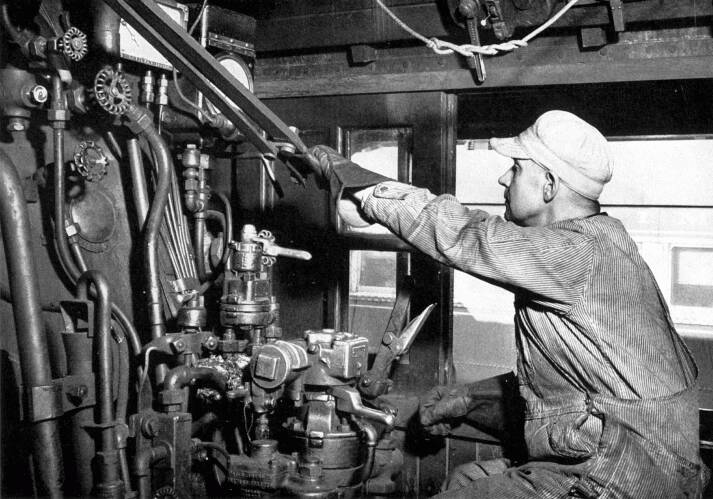
An engineer is a person who has evolved from a locomotive operator. He has a passion for all moving mechanical gadgets that have flashing lights and preferably make some kind of noise. Like trains do. As a young person he used to break up every toy he had just to find out what kind of parts it is made of, how it works and to find out whether he could put it backtogether. When an engineer grows up, he will enjoy nothing more than creating new gadgets of the above described kind.
This person owes everything to the philosophists, because without them, he would not have the foundation for making new gadgets. This is often forgotten from the engineers, who think philosophists are not creating things, they are just discussing things and writing a book or two on occasion.
Philosophists owe much to the engineers. Engineers have given philosophists tools to push further and further to the limits of understanding the world. This is often forgotten by the scientists and philosophists, who think engineers work short-sighted and focus on profit rather than common good. A computer is a good example. It was innovated by a philosophist, and productized by an engineer. Few philosophist would refuse to work without one nowadays.
Philosophy:
You might have heard phrases like "art of thinking" or something like that. Forget about all that nonsense, as it does not really mean anything. In fact classic philosophy is nothing but a super-science that actually contains schools for mathematics, physics, logic, chemistry, politics, metaphysics, social studies, and the list goes on and on. As you can see all natural sciences are automatically covered here, so for instance quantum physics and cosmology are part of philosophy, by this definition.
Merchants and salesmen: not philosophists. it is true that it is no other than Arabic merchants that took the modern number zero in use, from pure business need. But zero was actually invented before that, and what merchants innovated was actually a symbol for it, which made it easy to write and communicate. Practical people those merchants indeed, but we are going to leave them out from the philosophists category.
Clergy: not counted in as philosophists. Some priests might of course practice philosophy, like monk Roger Bacon, when he wanted to find out what light and rainbow were actually made of. His colleagues did not approve his hobby, and improsoned him for practicing black magic. For this reason priests not considered as philosophists, and teology not considered as philosophy. However, the study of religions (through psychology, history, anthropology, sociology etc.) is philosophy.
Medicine: Doctors have isolated themselves in their own discussion forums for a long, long time ago. Even if medicine has tight links to chemistry, doctors have subcontracted that competence from scientists. Even today, you are going to a very different school to study chemistry whether you want to put the chemical into a human body, or somewhere else. Therefore doctors are not considered as philosophists and practicing medicine not philosophy.
Engineer:
An engineer is a person who has evolved from a locomotive operator. He has a passion for all moving mechanical gadgets that have flashing lights and preferably make some kind of noise. Like trains do. As a young person he used to break up every toy he had just to find out what kind of parts it is made of, how it works and to find out whether he could put it backtogether. When an engineer grows up, he will enjoy nothing more than creating new gadgets of the above described kind.
This person owes everything to the philosophists, because without them, he would not have the foundation for making new gadgets. This is often forgotten from the engineers, who think philosophists are not creating things, they are just discussing things and writing a book or two on occasion.
Philosophists owe much to the engineers. Engineers have given philosophists tools to push further and further to the limits of understanding the world. This is often forgotten by the scientists and philosophists, who think engineers work short-sighted and focus on profit rather than common good. A computer is a good example. It was innovated by a philosophist, and productized by an engineer. Few philosophist would refuse to work without one nowadays.
Subscribe to:
Posts (Atom)